Hiring Your First Employee? 4 Payroll Setup Steps You Need to Know
🎉 Hiring Your First Employee? 4 Payroll Setup Steps You Need to Know!
Congratulations on hiring your first employee (or employees)! That’s a major milestone for any business—and one worth celebrating.
But let’s be honest: it’s not as simple as handing over a paycheck. (Wouldn’t that be nice?) From onboarding to payroll setup to year-end W-2s, there’s a lot to navigate. The good news? Some of the steps are one-time tasks, while others become part of your ongoing rhythm. Yes, it can feel daunting at first—but I promise, it gets easier with time and systems in place.
Poor payroll setup and maintenance can quietly sabotage your business—while a strong system builds trust and compliance.
Let’s walk through it together.
🧠 First, Let’s Clear Up the Terminology
Before we dive into the checklist, it’s important to define what we mean by “employee.”
An employee is someone your business hires, pays through payroll, withholds taxes for, and issues a W-2 at year-end.
A worker paid as an Independent Contractor (1099) is not an employee. That distinction matters—and the term “employee” should never be used when referring to a contractor.
We won’t go deep into the employee vs. contractor debate here (that’s a whole topic on its own), but using the correct terminology from the start helps you stay compliant and avoid confusion.
📋 What This Guide Covers
Below, you’ll find a detailed list of what needs to happen before hiring your first employee, and what you’ll need to do routinely once they’re on board. Effective payroll setup and maintenance are essential to your business's success. Keep in mind: depending on your state and industry, there may be additional filings, enrollments, or requirements to consider. Always check with your local regulations to stay on track.
🛠️ Step 1: Set up Your Business to Hire Employees
Before you can officially bring someone onto payroll, your business needs to be registered with the appropriate federal and state agencies. These registrations allow you to process payroll, remit taxes, and stay compliant with employment laws.
Here’s what you’ll need to do:
✅ Federal Requirements
Request an EIN (Employer Identification Number)
If you don’t already have one, apply through the IRS. This number identifies your business for tax purposes and is required to process payroll.
Enroll in the IRS EFTPS System
This is where you’ll remit federal payroll taxes, including:
Employee income tax withholding
Employer match for Social Security and Medicare
Federal Unemployment Tax (FUTA)
✅ State Requirements (Varies by State)
Register with the State Revenue Department
If your state collects income tax, this is where you’ll remit the portion withheld from employee paychecks.Register with the State Workforce Commission
This agency handles State Unemployment Tax, which is paid by the employer.Enroll in the State’s New Hire Reporting Program
You must report new hires within a set number of days. This helps the state track unemployment and child support obligations. Note: Many payroll providers file this automatically—check with yours to confirm.Apply for Worker’s Compensation Insurance
Depending on your state and industry, this may be required. Be sure to verify your obligations.
🗂️ Pro Tip: Stay Organized
Once you’ve registered with these agencies, store all paperwork and login credentials in a secure, easily accessible location. You’ll need to reference this information periodically, and recovering lost credentials can be a time-consuming hassle.
🧾 Step 2: Create Payroll Procedures
📌 Post Required Workplace Notices
Every employer is required to display certain workplace posters—yes, even if your team is fully remote.
Research industry-specific poster requirements for your state and federal obligations.
Determine where and how to post them. Physical workplaces need visible displays; virtual teams may require digital access.
Consider providers that offer both printed and online versions. Some services allow employees to log in and view required notices digitally, helping you stay compliant with minimal hassle.
📅 Set Your Payroll Schedule
This is one of the most important decisions you'll make. You’ll need to choose:
Pay frequency: Weekly, biweekly (every other week), semi-monthly, or monthly.
Consistency: Once you set a schedule, stick with it. Changing pay dates can cause confusion and compliance issues.
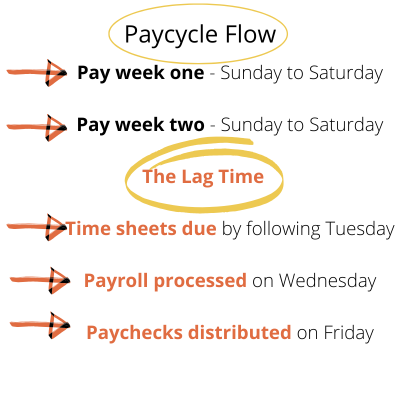
⏳ Define Lag Time Between Pay Period and Payday
Payroll isn’t instant—it requires time to collect hours, process data, and transfer funds. That’s where lag time comes in.
Example: Let’s say you pay employees every other Friday.
The pay period might run from Sunday to Saturday, over two weeks.
Timesheets and reimbursement forms are due the following Tuesday.
Payroll is processed midweek, and paychecks are issued Friday.
This 7-day lag allows time for:
Reviewing hours and reimbursements
Processing payroll accurately
Ensuring direct deposit clears through the bank
📊 Visual Example (See Graphic Below)
In the graphic, you’ll see how the pay cycle flows from workweek to payday, including deadlines for timesheet submission and payroll processing. This kind of visual is especially helpful for onboarding new employees or training your internal team.
🧩 Step 2 (Continued): Choose a Payroll System & Understand Labor Laws
Once your payroll schedule is set, it’s time to choose how you’ll actually run payroll.
🖥️ Select a Payroll System or Provider
You can:
Use payroll software to manage everything in-house
Outsource to a payroll provider who handles filings, payments, and compliance
Either way, make sure the system supports:
Direct deposit
Tax calculations and remittance
New hire reporting
W-2 and 1099 generation
📚 Learn Federal & State Payroll Laws
Understanding labor laws is non-negotiable. You’ll need to know:
Overtime rules
Required breaks and rest periods
Mandated benefits (like sick leave or disability insurance)
Pro Tip:
Just because you don’t want to pay overtime doesn’t mean you don’t have to. Federal law requires overtime pay at 1.5x the regular rate for hours worked over 40 in a workweek—unless the employee is classified as exempt.
Some states, like California, require overtime based on daily hours worked. Always check your state’s specific laws.
🗂️ Step 3: Collect Employee Paperwork
Each new hire must complete several forms. These help you stay compliant and organized.
Required Documents
Job Application – Keep on file for reference and documentation
I-9 Form – Verifies identity and employment eligibility
W-4 Form – Determines federal income tax withholding
Direct Deposit Authorization – If applicable
Equipment Agreement – If you issue laptops, phones, or other gear
Pro Tip:
Keep I-9 forms separate from employee files. If a government agency requests to inspect them, you’ll only need to provide the I-9—not the entire personnel file.
💸 Step 4: Payroll Taxes & Form Filing
Once payroll is processed, your responsibility doesn’t end there. You must remit taxes and file forms on a strict schedule.
Common Payroll Taxes
941 - Employee withholding + employer match for Social Security & Medicare
Filing Frequency: Monthly or semi-weekly
940 - Federal Unemployment Tax (FUTA)
Filing Frequency: Annually or quarterly
State Unemployment - Employer-paid tax, varies by state (e.g., quarterly in Texas)
Filing Frequency: Quarterly
State Payroll Tax - Withheld from employee pay, if applicable in your state
Filing Frequency: Varies by state
Required Form Filings
For each tax, there’s a corresponding form:
Form 941 – Filed quarterly to reconcile payroll and payments
Form 940 – Filed annually for FUTA
State Unemployment Forms – Filed quarterly
State Payroll Tax Forms – Filed per your state’s schedule
W-2 – Issued to employees in January; your business also files a W-3 with the IRS
🧠 Final Thoughts
There’s more to payroll than just cutting checks. Effective payroll setup and maintenance aren’t just operational—they’re essential to your business’s success. You need systems, schedules, and safeguards to stay compliant and avoid costly mistakes.
Takeaway:
Create a payroll calendar with due dates for payments and filings. Missing deadlines can lead to penalties, interest, and a compliance mess that’s hard to untangle.
Stay organized. Stay diligent. And remember—you don’t have to do it alone.
Got questions? We've got answers. Don't wait to get clarity on payroll.
The article is for informational purposes only and should not be construed as business, accounting, tax, or legal advice. Details are subject to change without notice.
Copyright © 2019-2025, Alpha Omega Consulting & Bookkeeping, LLC DBA The Sensible Business Owner, ALL RIGHTS RESERVED